Contents
- Introduction
- Solar for Data Centres Malaysia
- Why Data Centres in Malaysia Need Renewable Energy
- What Is Solar for Data Centres?
- Why Solar Makes Sense for Data Centres in Malaysia
- What Is CRESS and Why Is It Relevant to Data Centres?
- How Much Solar Does a Data Centre Need?
- Planning Solar for a Data Centre in Malaysia
- Build a More Sustainable Data Centre with Arus EnerG
- Frequently Asked Questions
Choose Safe, Reliable Solar with Arus EnerG
Contact Arus EnerG today for a free consultation and discover how safe, efficient solar energy can power your property for decades.
Introduction
Malaysia is rapidly developing into a major data centre hub in Southeast Asia. From cloud computing and artificial intelligence to e-commerce and digital banking, increasing demand for digital services is driving the construction of larger and more energy-intensive data centres.
Unlike conventional commercial buildings, data centres operate continuously. Servers, networking equipment, cooling systems, security infrastructure and backup systems require electricity 24 hours a day, 365 days a year. This makes energy availability, electricity costs and sustainability important considerations for data centre operators.
One solution is renewable energy — particularly solar for data centres in Malaysia.
Solar photovoltaic (PV) systems can help data centre operators generate renewable electricity on-site. They can also reduce dependence on grid electricity during daylight hours and support broader sustainability and carbon-reduction strategies. For larger facilities with electricity demand beyond what rooftop solar can provide, solar can form part of a wider renewable energy strategy. This wider strategy can also involve battery storage and renewable electricity procurement.
Solar for Data Centres Malaysia
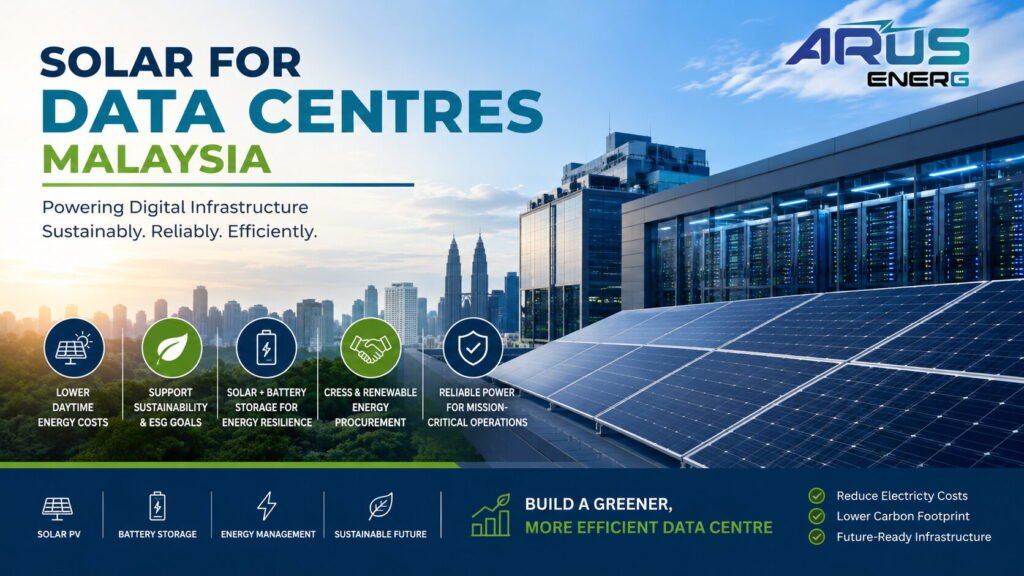
Why Data Centres in Malaysia Need Renewable Energy
Data centres are among the most electricity-intensive commercial and industrial facilities. Their electricity consumption extends beyond the servers themselves.
Significant energy is also required for other supporting systems, including:
- Cooling and ventilation
- Power distribution
- Network infrastructure
- Lighting
- Monitoring systems
Malaysia's growing data centre sector therefore creates significant additional electricity demand.
According to information reported through the Malaysian Investment Development Authority (MIDA), Malaysia had 18 data centres as of February 2025, with a combined electricity demand of at least 800 MW. The number of data centres is expected to increase substantially by 2035.
Malaysia has also introduced sustainability guidelines for data centres covering areas such as energy efficiency, renewable energy and water efficiency. For operators, renewable energy is therefore becoming increasingly relevant to both operational planning and long-term sustainability strategies.
What Is Solar for Data Centres?
Solar for data centres involves installing photovoltaic panels that convert sunlight into electricity for use within the facility.
A typical commercial or industrial solar installation may include:
- High-efficiency solar PV modules
- Commercial or utility-scale inverters
- Mounting structures
- Electrical protection equipment
- Monitoring systems
- Distribution board integration
- Optional Battery Energy Storage System (BESS)
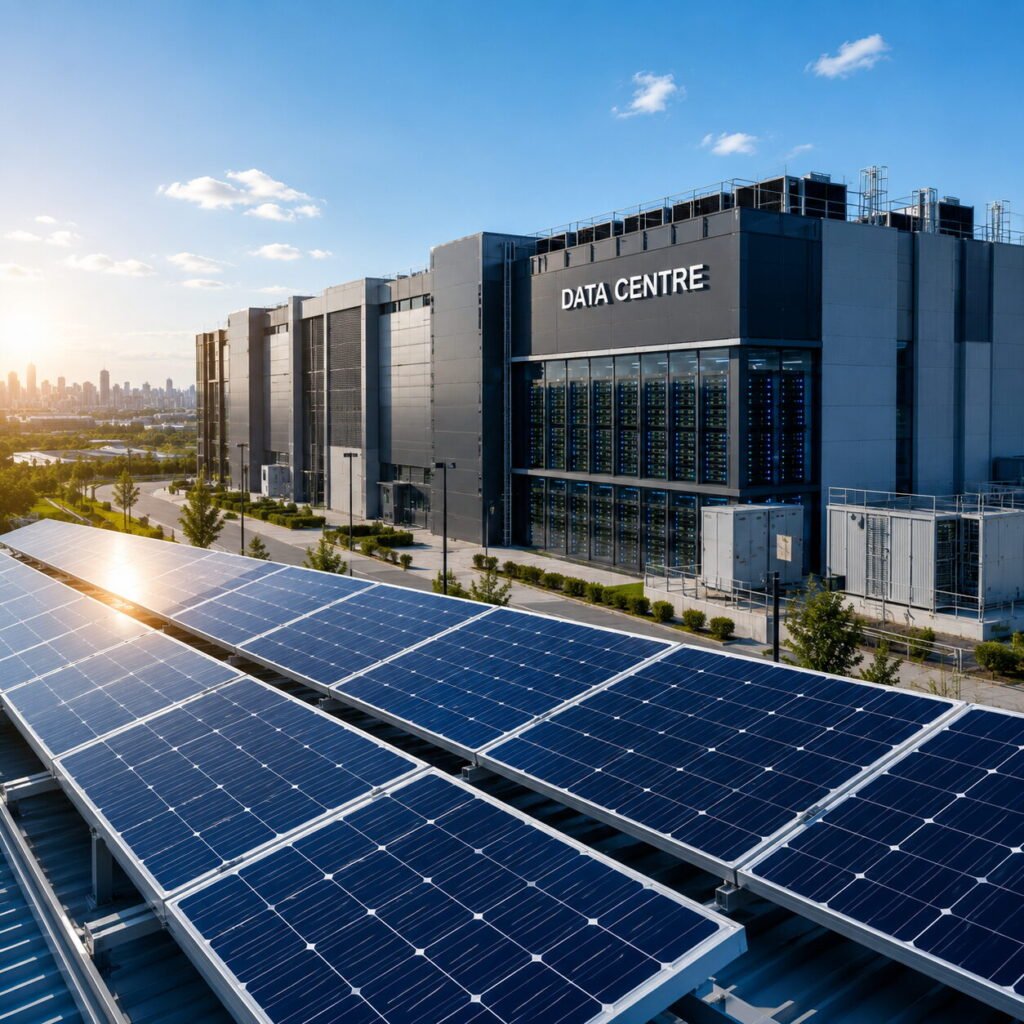
Solar panels can potentially be installed on data centre rooftops, car parks, surrounding land or other suitable areas.
The electricity generated can then offset part of the facility's daytime electricity consumption. However, because data centres operate continuously and often have extremely high power requirements, solar should generally be considered one component of a broader energy strategy rather than a standalone power source.
Why Solar Makes Sense for Data Centres in Malaysia
1. High and Consistent Electricity Demand
Data centres typically maintain significant electrical loads throughout the day. This creates a useful consumption profile for solar because electricity generated during daylight hours can potentially be consumed directly by the facility rather than remaining unused.
The actual contribution will depend on available installation space, solar capacity, facility load profile and system design.
2. Reduce Daytime Grid Electricity Consumption
When a solar PV system generates electricity, the facility can consume that electricity before drawing the equivalent amount from the grid, subject to the system configuration and applicable regulations.
For a facility with substantial daytime demand, even partial solar coverage can translate into meaningful reductions in grid electricity consumption over the system's operating life.
3. Support Sustainability and ESG Objectives
Renewable electricity can contribute to corporate sustainability strategies and carbon-reduction initiatives. This is particularly relevant for multinational companies, hyperscale operators, cloud providers and technology companies that may have internal renewable energy or decarbonisation targets.
Malaysia's Guideline for Sustainable Development of Data Centre specifically aims to accelerate the use of renewable or clean energy to provide lower-carbon energy for data centre operations.
4. Make Productive Use of Available Space
Large data centre developments may have several potential areas for solar installation. These can include:
Rooftops
Large flat roofs can potentially accommodate substantial solar arrays.
Car parks
Solar carports generate electricity while providing shaded parking.
Surrounding land
Large campuses may have suitable land for ground-mounted solar installations.
Using several installation areas together can increase the renewable generation potential of a site.
5. Improve Long-Term Energy Planning
Electricity is a major operating consideration for data centres. On-site solar provides a source of electricity generated directly at the facility, allowing businesses to diversify how part of their electricity requirement is supplied.
A feasibility assessment can model expected solar generation against the facility's actual consumption profile to determine the potential technical and financial impact.
Want to know how much you can save?
Send us your TNB bill and we will work out the system size and cost. Free, no commitment.
What Is CRESS and Why Is It Relevant to Data Centres?
The Corporate Renewable Energy Supply Scheme (CRESS) provides another pathway for Malaysian businesses seeking access to renewable electricity. Under CRESS, eligible corporate consumers can source renewable electricity from renewable energy developers through Malaysia's electricity network under a third-party access framework.
This can be particularly relevant for data centres. A hyperscale data centre may consume far more electricity than can be generated from solar panels installed on its own rooftop.
CRESS allows renewable electricity procurement to extend beyond the physical boundaries of the data centre site, subject to eligibility, technical requirements, agreements and applicable charges.
Malaysia's Energy Commission published updated CRESS guidelines in January 2026. For large data centres, a renewable energy strategy could therefore combine:
On-site Solar PV + BESS + Grid Electricity + CRESS
The appropriate combination depends on electricity demand, site constraints, renewable energy targets, reliability requirements and project economics.
How Much Solar Does a Data Centre Need?
There is no standard solar system size for a data centre. The appropriate capacity depends on several factors:
- Total electricity consumption
- Daytime load profile
- Maximum demand
- Available roof or land area
- Solar irradiation
- Electrical infrastructure
- Renewable energy targets
- Project budget
- Future expansion plans
For example, a smaller enterprise data centre may be able to offset a meaningful portion of its daytime consumption using rooftop solar. A hyperscale facility consuming tens or hundreds of megawatts may require a much broader renewable energy strategy involving utility-scale renewable generation and electricity procurement.
This is why the first step should be an energy and site assessment rather than selecting a solar capacity based solely on building size.
Planning Solar for a Data Centre in Malaysia
A data centre solar project should begin with a comprehensive technical assessment.
- Electricity consumption analysis
Review historical electricity bills, maximum demand and load profiles. - Site assessment
Evaluate rooftop, parking and land availability. - Technical feasibility study
Determine appropriate solar capacity and electrical integration. - Solar generation modelling
Estimate annual renewable electricity production. - Financial analysis
Evaluate projected electricity savings, investment requirements and potential payback. - System engineering
Design the PV system around the facility's electrical and operational requirements. - Regulatory and utility requirements
Determine applicable programmes, approvals and technical requirements. - Installation and commissioning
Install, test and commission the system according to approved specifications. - Monitoring and maintenance
Monitor system performance and conduct ongoing preventive maintenance.
Build a More Sustainable Data Centre with Arus EnerG
Malaysia's data centre industry is expanding rapidly, and electricity will remain one of the sector's most important operational considerations. Solar energy provides data centre operators with an opportunity to generate renewable electricity directly at their facilities while supporting long-term sustainability objectives.
For larger energy requirements, solar can also form part of an integrated strategy involving battery storage and renewable electricity procurement. The right solution starts with understanding your facility.
Frequently Asked Questions
Can solar panels power a data centre in Malaysia?
Yes, solar panels can supply part of a data centre's electricity requirement. However, because data centres operate continuously and often have very high electricity demand, most facilities will still require grid electricity and other power infrastructure.
Can a data centre run 100% on solar energy?
Running a large data centre directly from on-site solar alone is generally impractical because solar generation is intermittent and installation space is limited. A broader renewable energy strategy may combine solar, battery storage, grid electricity and renewable electricity procurement.
How much solar does a data centre need?
The required capacity depends on electricity consumption, load profile, available roof or land area and the operator's renewable energy targets. A technical feasibility study is required to determine an appropriate system size.
Can solar panels be installed on a data centre roof?
Yes, provided the roof has sufficient usable area and structural capacity. Structural condition, shading, equipment placement, maintenance access and safety requirements should be assessed before installation.
Can solar batteries be used for data centres?
Yes. Battery Energy Storage Systems can be integrated with solar for energy management and renewable energy utilisation. Their role should be engineered carefully and should not automatically be treated as a substitute for mission-critical UPS or emergency backup systems.
What is CRESS for data centres in Malaysia?
The Corporate Renewable Energy Supply Scheme (CRESS) enables eligible corporate consumers to source renewable electricity from renewable energy developers through the electricity network under Malaysia's third-party access framework. It may be useful for data centres whose renewable electricity requirements exceed their available on-site solar capacity.
Is solar suitable for hyperscale data centres?
Yes, but on-site solar will normally represent only part of the overall electricity requirement. Hyperscale facilities may need a combination of on-site solar, large-scale renewable energy, storage and external renewable electricity procurement.
How can Arus EnerG help?
Arus EnerG can assess the facility's electricity consumption, available space and operational requirements before recommending an appropriate commercial solar solution.
Ready to start?
Talk to the Arus EnerG team first. We can survey your roof and give you real numbers before you decide.
Related posts
- Solar Untuk Pusat Data Malaysia
Nak jawapan khusus untuk kes anda?Artikel ni cover asasnya. Untuk angka dan cadangan yang tepat ikut bumbung dan...
14 August 20260LikeBy Arus EnerG - Solar Safety Standards in Malaysia
Have Questions About Solar for Your Property? Talk to our team to find the right solar solution for...
- Apa Itu Solar + Battery?
Ada Soalan Tentang Solar untuk Anda? Berbincang dengan pakar kami untuk dapatkan cadangan sistem solar yang sesuai dengan...