Contents
- Option 1: Bank Loans for Solar (Green Financing)
- Option 2: Islamic Solar Financing (Zero Riba)
- Option 3: 0% Easy Payment Plan (Credit Card Instalment)
- Option 4: EPF Akaun Fleksibel (Account 3) Withdrawal
- Option 5: Power Purchase Agreement (PPA) for Businesses
- Financing Comparison at a Glance
- How Much Do You Actually Need to Finance?
- How to Choose the Right Financing Option
- Frequently Asked Questions
- Need Help Choosing the Right Financing Option?
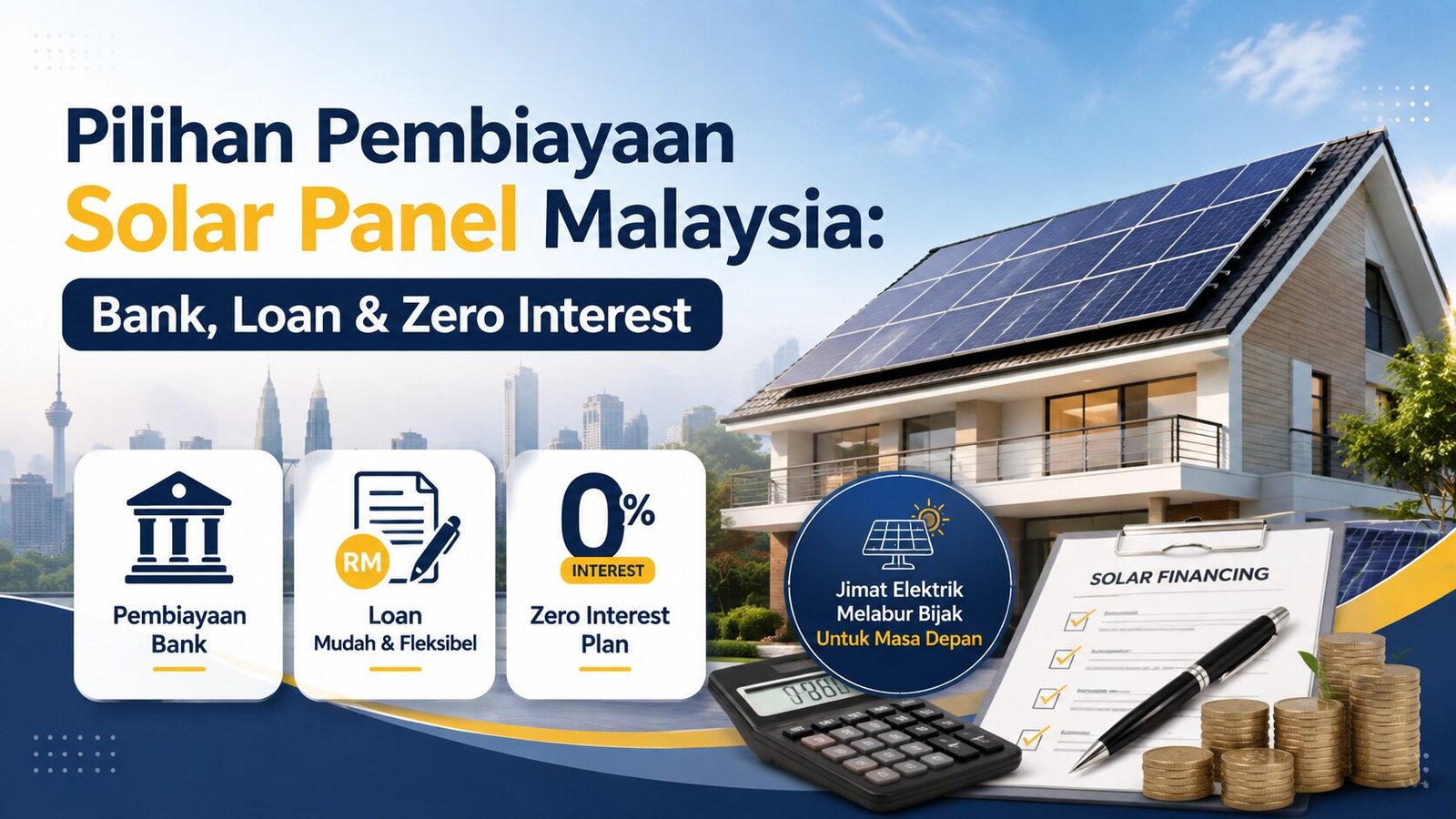
Solar financing in Malaysia is one of the first things most homeowners and business owners ask about before going solar — and for good reason, since a residential system typically runs from RM15,000 to RM40,000+ before any financing. This guide breaks down every real financing route available in Malaysia in 2026, including current guidance referenced from Bank Negara Malaysia.
Quick answer: There are five main ways to finance solar in Malaysia — (1) a conventional bank loan or green loan, (2) Islamic/Shariah-compliant financing (zero riba), (3) a 0% easy payment plan (EPP) through a credit card, (4) an EPF Akaun Fleksibel (Account 3) withdrawal, and (5) for businesses, a Power Purchase Agreement (PPA) with zero upfront capex. None of these require you to pay the full system cost in cash.
Option 1: Bank Loans for Solar (Green Financing)
Several major banks in Malaysia offer green financing or personal loan products that cover solar panel installation, including Maybank, CIMB, RHB, and Public Bank. Interest rates and terms vary by bank and by your credit profile — always get a current rate quote directly from the bank before deciding. A solar-specific bank loan typically runs 3–10 years, and most installers (including Arus EnerG) can point you to banks that already have experience approving solar loan applications, which tends to speed up processing.
If you’ve been searching for a solar loan, a solar panel bank loan, or which banks offering solar financing in Malaysia, this is usually the starting point — it’s the most widely available option and works for both residential and commercial systems.
Option 2: Islamic Solar Financing (Zero Riba)
Bank Islam and other Islamic financial institutions offer Shariah-compliant financing structures for solar (commonly murabahah or ijarah contracts), marketed as “zero riba” financing. This structure suits buyers who specifically want a fully Shariah-compliant option rather than a conventional interest-based loan. Overall cost can be comparable to a conventional loan — compare the actual profit rate and terms, not just the label.
Option 3: 0% Easy Payment Plan (Credit Card Instalment)
Some solar installers partner with banks to offer 0% interest instalment plans through credit cards, usually over 12–36 months. This is one of the most common answers to “interest free solar panel loans” — it avoids a formal loan application, but your credit card limit becomes the ceiling, which can be a constraint for a larger residential or commercial system. It’s best suited to smaller systems or as a way to finance part of the cost alongside another option below.
Option 4: EPF Akaun Fleksibel (Account 3) Withdrawal
As covered in our guide on using EPF to pay for solar panels, the Akaun Fleksibel (Account 3) allows a free-purpose withdrawal — including for solar — as long as you keep the required minimum balance. It has no interest and no approval process, but weigh the impact on your retirement savings before using it as your main financing route.
Option 5: Power Purchase Agreement (PPA) for Businesses
Businesses that don’t want to carry upfront capex can use a PPA structure — a solar provider installs and owns the system on your premises, and you simply pay for the electricity you use at a rate lower than TNB’s tariff. This is one of the most common structures behind commercial solar loans searches, though technically a PPA isn’t a loan at all — there’s no debt on your balance sheet, and it’s popular for factories and larger commercial buildings that want savings without financing paperwork.
Financing Comparison at a Glance
| Option | Best For | Upside | Trade-off |
|---|---|---|---|
| Bank loan / green loan | Individuals & businesses with good credit | Flexible repayment terms, widely available | Interest charged, application process |
| Islamic financing | Buyers who want Shariah compliance | Zero-riba structure | Terms may differ from conventional loans |
| 0% EPP (credit card) | Small-to-medium systems | No interest, fast approval | Capped by card limit, shorter tenure |
| EPF Akaun Fleksibel | Those with sufficient balance | No interest, no approval process | Reduces retirement savings |
| PPA (businesses) | Factories / large commercial buildings | Zero upfront capex | You don’t own the system, long-term contract |
How Much Do You Actually Need to Finance?
Before comparing loan or instalment options, it helps to know the real number. See our full breakdown of solar panel cost in Malaysia for residential systems, or solar cost for businesses if you’re financing a commercial installation. Financing the full amount isn’t always necessary either — many homeowners combine a partial cash/EPF payment with a smaller loan to reduce total interest paid.
How to Choose the Right Financing Option
- Work out the amount you actually need (see the cost guides linked above)
- Decide your priority — lowest interest rate, fastest approval, or full Shariah compliance
- Get an official quote directly from the bank or institution before committing to anything
- Ask your installer — some, including Arus EnerG, have direct bank partnerships that speed up loan applications
Frequently Asked Questions
1. What’s the cheapest way to finance solar in Malaysia?
It depends on current interest rates and your repayment period. A 0% EPP or an EPF Akaun Fleksibel withdrawal are technically “interest-free,” but each comes with its own trade-off (credit limit or reduced retirement savings) — they’re not automatically the cheapest option overall.
2. Can I combine more than one financing option?
Yes — a common approach is paying part in cash or via EPF and financing the remaining balance through a bank loan, which reduces the total loan amount and interest paid.
3. Which banks offer solar loans or solar financing in Malaysia?
Maybank, CIMB, RHB, and Public Bank are among the major banks offering green financing or personal loans that can be used for solar. Bank Islam and other Islamic banks offer Shariah-compliant equivalents. Always confirm current rates directly with the bank.
4. Is Islamic solar financing the same cost as a conventional loan?
The structure is different (profit rate vs. interest rate), but overall cost can be comparable — compare the actual figures and terms rather than the label alone.
5. What is a PPA and how does it work for solar?
A Power Purchase Agreement (PPA) is where a solar provider installs and owns the system on your property, and you only pay for the electricity generated, at a rate below TNB’s tariff — with no upfront installation cost.
6. How long is a typical solar loan or instalment plan?
Usually between 3 and 10 years, depending on the financing type and loan amount.
7. Do I need insurance if my solar system is financed through a loan?
Some banks require insurance as part of the loan terms — check directly with the bank or financial institution you’re applying with.
8. Can small businesses (SMEs) get green financing for solar?
Yes — many banks have SME-specific green financing packages. Eligibility depends on the business’s credit profile.
9. Are there government loans or subsidies for solar panels in Malaysia?
Malaysia’s main solar incentive is Net Energy Metering (NEM), which lets you offset your TNB bill with exported solar energy, rather than a direct government loan. Financing itself typically comes through banks, EPF, or PPA structures as covered above — ask your installer which current incentives apply to your setup.
10. I’m not sure which financing option is right for me — what should I do?
Talk to the Arus EnerG team — we can walk through the trade-offs of each option based on your actual budget and system size before you commit to anything.
Need Help Choosing the Right Financing Option?
Everyone’s financial situation is different. Arus EnerG can help explain which option makes the most sense for you.
Chat with Arus EnerG on WhatsApp about financing options
Related articles: How to Use EPF to Pay for Solar Panels | Solar Panel Cost in Malaysia | Solar Panel Cost for Factories & Businesses | Baca dalam Bahasa Malaysia: Pilihan Pembiayaan Solar Panel
Note: Interest/profit rates and financing terms change over time — always confirm current figures directly with the relevant bank or institution.
Ready to get started?
Talk to the Arus EnerG team first. We can do a site survey and give you real numbers before you decide.
- Feed-in Tariff Malaysia: Is FiT Still Available in 2026?
Quick answer: The Feed-in Tariff (FiT) in Malaysia has been closed to new registrations since 2021 for rooftop...
- Is Solar Worth It in Malaysia?
Have Questions About Solar for Your Property? Talk to our team to find the right solar solution for...
- SuRIA Home Rebate 2026: RM3,000, Eligibility & Deadline
The SuRIA Home rebate pays RM600/kWac up to RM3,000 for Solar ATAP homeowners. Eligibility, how it is claimed,...