Contents
- Introduction
- Office Electricity Saving Tips for Businesses
- Why Should Businesses Reduce Office Electricity Consumption?
- 1. Optimise Air Conditioning Usage
- 2. Switch Off Lights in Unused Areas
- 3. Replace Traditional Lighting With LED Lights
- 4. Make Better Use of Natural Daylight
- 5. Enable Power-Saving Settings on Computers
- 6. Switch Off Unused Office Equipment
- 7. Choose Energy-Efficient Office Equipment
- 8. Maintain Air Conditioning and Electrical Equipment
- 9. Reduce Heat Entering the Office
- 10. Consider Solar Energy for Your Office
- Start Reducing Your Office Electricity Costs
- Frequently Asked Questions
Choose Safe, Reliable Solar with Arus EnerG
Contact Arus EnerG today for a free consultation and discover how safe, efficient solar energy can power your property for decades.
Introduction
Electricity is an essential operating cost for almost every business. From air conditioning and lighting to computers, servers and office equipment, a typical workplace consumes electricity throughout the working day.
For businesses in Malaysia, where air conditioning is used heavily due to the tropical climate, electricity costs can represent a significant portion of monthly overheads.
The good news is that businesses do not always need major renovations to reduce electricity consumption. Simple changes in daily habits, equipment settings and energy management can make a meaningful difference.
Here are practical office electricity saving tips for businesses in Malaysia that can help improve energy efficiency and potentially lower monthly electricity bills.
Office Electricity Saving Tips for Businesses
- Why Should Businesses Reduce Office Electricity Consumption?
- 1. Optimise Air Conditioning Usage
- 2. Switch Off Lights in Unused Areas
- 3. Replace Traditional Lighting With LED Lights
- 4. Make Better Use of Natural Daylight
- 5. Enable Power-Saving Settings on Computers
- 6. Switch Off Unused Office Equipment
- 7. Choose Energy-Efficient Office Equipment
- 8. Maintain Air Conditioning and Electrical Equipment
- 9. Reduce Heat Entering the Office
- 10. Consider Solar Energy for Your Office
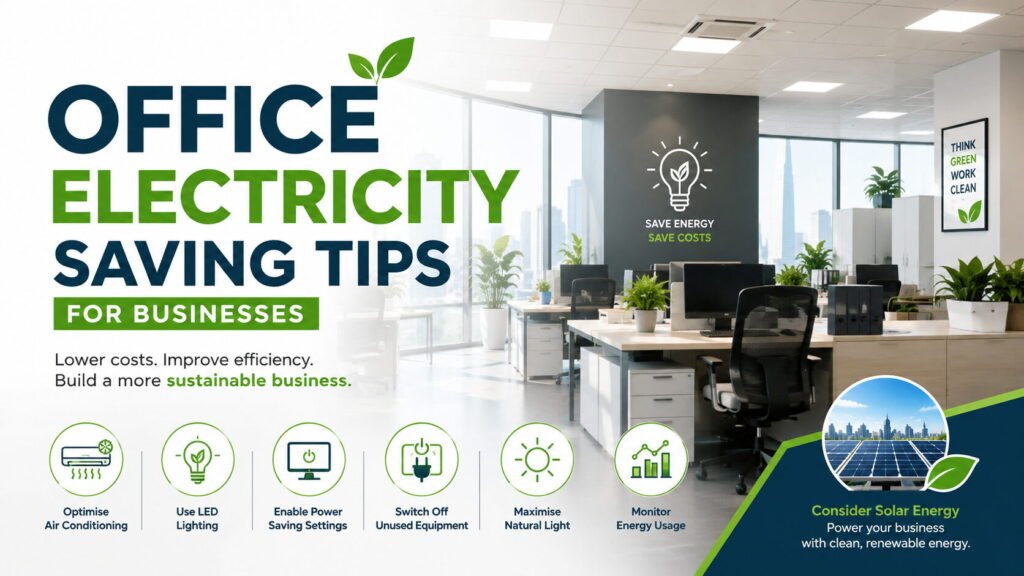
Why Should Businesses Reduce Office Electricity Consumption?
Reducing electricity usage is not only about lowering utility bills. Improving energy efficiency can also support better cost management and sustainability initiatives.
For businesses operating offices, commercial buildings or multiple branches, even relatively small improvements can add up when applied consistently.
Potential benefits include:
- Lower monthly electricity expenses
- Reduced unnecessary energy consumption
- Better operational efficiency
- Lower environmental impact
- Support for corporate sustainability and ESG initiatives
- Better preparation for adopting renewable energy solutions such as solar
Understanding where electricity is being used is the first step towards improving efficiency.
1. Optimise Air Conditioning Usage
Air conditioning is often one of the largest electricity consumers in Malaysian offices.
Setting the temperature unnecessarily low forces the system to work harder and consume more electricity.
Businesses can improve air-conditioning efficiency by:
- Setting office temperatures at a comfortable and efficient level
- Keeping doors and windows closed while air conditioning is operating
- Cleaning air filters regularly
- Scheduling routine servicing
- Switching off air conditioning in unused rooms
- Using timers or centralised controls where appropriate
Employees should also avoid adjusting thermostats repeatedly throughout the day.
2. Switch Off Lights in Unused Areas
Meeting rooms, storage areas, pantries and other spaces are sometimes left illuminated even when nobody is using them.
Encourage employees to switch off lights when leaving these areas.
Businesses can also consider installing:
- Motion sensors
- Occupancy sensors
- Automatic lighting controls
- Timers
These systems help reduce electricity wastage without depending entirely on employees remembering to switch lights off.
3. Replace Traditional Lighting With LED Lights
If your office still uses fluorescent tubes or older lighting technologies, upgrading to LED lighting can improve energy efficiency. LED lights generally consume less electricity and have longer operating lifespans than many conventional lighting options.
For larger offices with dozens or hundreds of light fittings, the cumulative electricity savings can become significant over time.
4. Make Better Use of Natural Daylight
Malaysia receives abundant daylight throughout the year. Offices with suitable windows can reduce their reliance on artificial lighting during daytime hours.
Consider arranging desks and workspaces so employees can benefit from natural light while avoiding excessive glare and heat. Blinds, tinted windows or suitable window treatments can also help control direct sunlight.
5. Enable Power-Saving Settings on Computers
Computers are essential office equipment, but they do not need to operate at full power when employees are away from their desks. Configure computers to automatically enter sleep mode after a period of inactivity.
Employees should also be encouraged to shut down their computers at the end of the working day when appropriate rather than leaving them running overnight. For companies with many workstations, these small changes can reduce unnecessary electricity consumption.
Want to know how much you can save?
Send us your TNB bill and we will work out the system size and cost. Free, no commitment.
6. Switch Off Unused Office Equipment
Printers, monitors, photocopiers, chargers and other devices can continue consuming electricity when they are left switched on unnecessarily. Create a simple end-of-day routine for employees. Before leaving the office, check whether non-essential equipment can safely be switched off.
Smart plugs and programmable timers can also help automate this process.
7. Choose Energy-Efficient Office Equipment
When replacing computers, monitors, refrigerators, air conditioners or other appliances, electricity consumption should be considered alongside the purchase price. A cheaper appliance may cost more to operate over its lifetime if it consumes significantly more electricity. Businesses should compare energy-efficiency ratings and estimated operating costs when purchasing new equipment.
8. Maintain Air Conditioning and Electrical Equipment
Poorly maintained equipment may operate less efficiently. Air-conditioning systems, in particular, should receive regular servicing to maintain performance. Dirty filters, blocked airflow and poorly maintained components can make the system work harder than necessary. Establishing a preventive maintenance schedule can support both energy efficiency and equipment reliability.
9. Reduce Heat Entering the Office
When more heat enters a building, the air-conditioning system has to work harder to maintain a comfortable indoor temperature.
Businesses can consider measures such as:
- Window films
- Blinds and curtains
- Roof insulation
- Shading
- Improved building insulation
- Energy-efficient glazing
The most suitable approach depends on the building's design and orientation.
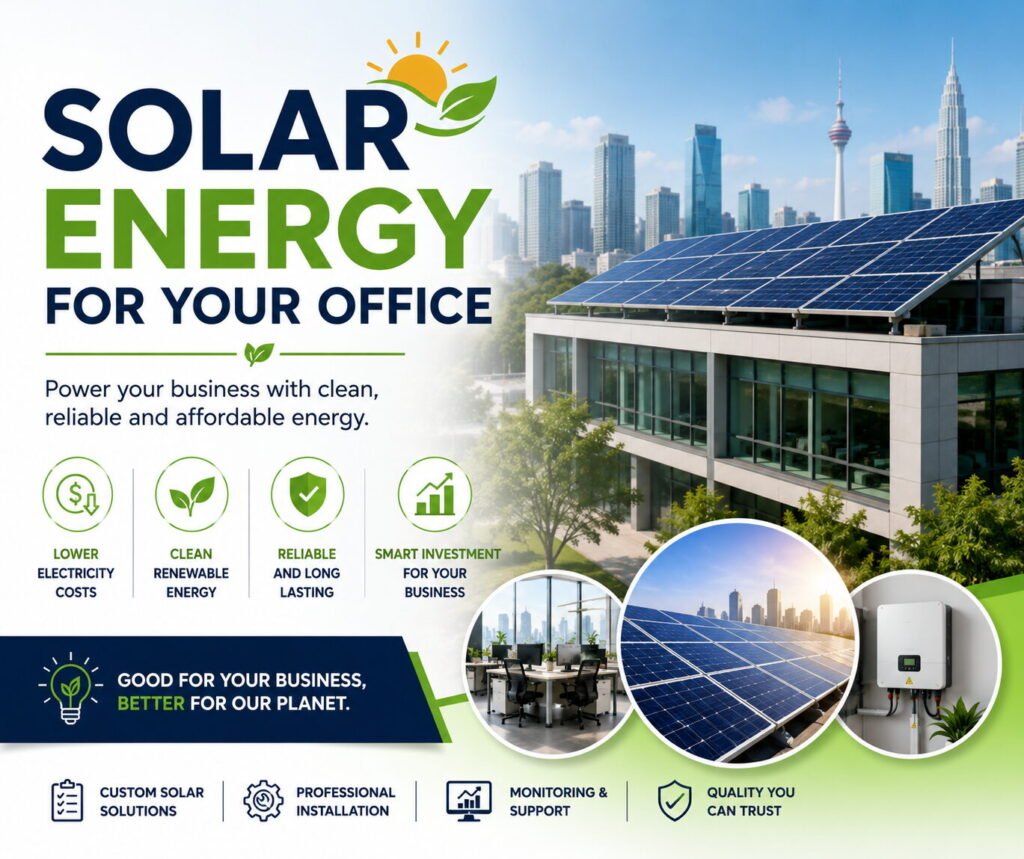
10. Consider Solar Energy for Your Office
After improving energy efficiency, businesses can explore generating part of their electricity using solar energy.
Malaysia's strong year-round solar resources make commercial rooftop solar an option worth evaluating for offices and other commercial properties. Solar panels generate electricity during daylight hours, which often overlaps with normal office operating hours.
This makes offices with consistent daytime electricity consumption potentially suitable for commercial solar. Depending on the property, electricity consumption and available installation area, solar may help businesses reduce their dependence on grid electricity and manage long-term energy costs.
Start Reducing Your Office Electricity Costs
There is no single solution for reducing office electricity consumption. The most effective approach combines better employee habits, efficient equipment, proper maintenance, energy monitoring and suitable building improvements. Once unnecessary consumption has been reduced, businesses can also explore commercial solar solutions as part of a longer-term energy strategy.
Arus EnerG provides solar solutions for businesses in Malaysia, from initial assessment and system planning to installation and ongoing support.
Talk to Arus EnerG About Commercial Solar
Want to understand whether solar is suitable for your office or commercial property? Contact Arus EnerG to discuss your electricity consumption, available installation space and potential commercial solar options.
Frequently Asked Questions
How can an office reduce its electricity bill?
Businesses can reduce office electricity consumption by optimising air-conditioning usage, switching to LED lighting, turning off unused equipment, enabling computer power-saving settings, maintaining equipment and monitoring electricity consumption.
What uses the most electricity in an office?
This varies between workplaces, but air conditioning is often a major electricity consumer in Malaysian offices. Computers, lighting, servers and other office equipment can also contribute significantly.
Does switching off computers save electricity?
Yes. Switching off computers when they will not be used for extended periods can reduce unnecessary electricity consumption. Sleep settings can also help reduce consumption during shorter periods of inactivity.
Are LED lights better for office electricity savings?
LED lighting generally consumes less electricity and lasts longer than many conventional lighting technologies, making it a common energy-efficiency upgrade for commercial premises.
Can solar panels reduce office electricity bills?
Solar panels can generate electricity during daylight hours, potentially reducing the amount of grid electricity a business needs to purchase. Actual savings depend on system size, solar generation, electricity consumption patterns and other factors.
Is commercial solar suitable for small offices?
Potentially. Suitability depends more on factors such as electricity usage, available installation space, building conditions and operating patterns than simply the size of the business.
Also available in Bahasa Malaysia: read the Malay version of this article.
Ready to start?
Talk to the Arus EnerG team first. We can survey your roof and give you real numbers before you decide.
Related posts
- Skim Solar Malaysia: Dari FiT ke NEM ke Solar ATAP
Tiga generasi skim solar kediaman Malaysia disusun ikut kronologi: Feed-in Tariff, NEM, Solar ATAP, plus rebat SolaRIS dan...
22 August 20260LikeBy Arus EnerG - Solar Company Kedah
Key Takeaways: Solar company KedahThis guide explains solar company Kedah for homeowners and businesses in Malaysia, based on...
14 August 20260LikeBy Arus EnerG - Memahami Caj Maximum Demand di Malaysia
Nak jawapan khusus untuk kes anda?Artikel ni cover asasnya. Untuk angka dan cadangan yang tepat ikut bumbung dan...
14 August 20260LikeBy Arus EnerG