Contents
- Introduction
- Why Engineering Matters in Solar Installation
- What Does Engineering Mean in Solar Installation
- 1. Proper System Sizing
- 2. Structural Safety of the Roof
- 3. Optimising Solar Panel Layout
- 4. Correct Inverter Sizing
- 5. Electrical Safety
- 6. Cable Sizing and Energy Losses
- 7. Protection Against Electrical Faults
- 8. Better Solar Performance
- 9. Accurate Energy Yield Estimation
- 10. Compliance With Malaysian Requirements
- Choose Engineering-Driven Solar Installation
- Frequently Asked Questions (FAQ)
Choose Safe, Reliable Solar with Arus EnerG
Contact Arus EnerG today for a free consultation and discover how safe, efficient solar energy can power your property for decades.
Introduction
Installing solar panels may look straightforward: mount panels on a roof, connect an inverter, and start generating electricity. In reality, a reliable solar energy system requires much more than good-quality equipment.
Engineering is one of the most important parts of a successful solar installation.
Proper engineering covers many tasks: assessing roof conditions, calculating electrical loads, selecting equipment and designing protection systems. Together, these steps help ensure that a solar PV system is safe, efficient, compliant, and suitable for long-term operation.
For homeowners and businesses in Malaysia, understanding the engineering behind solar installation can also help you choose the right solar provider and avoid costly problems later.
Why Engineering Matters in Solar Installation
- What Does Engineering Mean in Solar Installation?
- 1. Proper System Sizing
- 2. Structural Safety of the Roof
- 3. Optimising Solar Panel Layout
- 4. Correct Inverter Sizing
- 5. Electrical Safety
- 6. Cable Sizing and Energy Losses
- 7. Protection Against Electrical Faults
- 8. Better Solar Performance
- 9. Accurate Energy Yield Estimation
- 10. Compliance With Malaysian Requirements
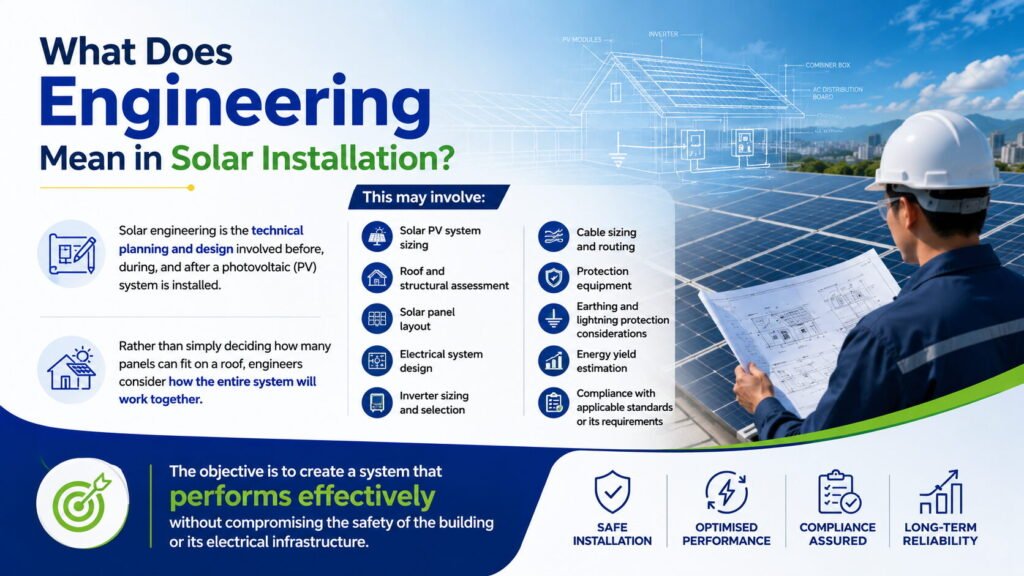
What Does Engineering Mean in Solar Installation
Solar engineering is the technical planning and design involved before, during, and after a photovoltaic (PV) system is installed.
Rather than simply deciding how many panels can fit on a roof, engineers consider how the entire system will work together.
This may involve:
- Solar PV system sizing
- Roof and structural assessment
- Solar panel layout
- Electrical system design
- Inverter sizing and selection
- Cable sizing and routing
- Protection equipment
- Earthing and lightning protection considerations
- Energy yield estimation
- Compliance with applicable standards and requirements
The objective is to create a system that performs effectively without compromising the safety of the building or its electrical infrastructure.
1. Proper System Sizing
One of the first engineering considerations is determining the appropriate size of the solar PV system.
A system should not be designed based solely on the available roof area. Engineers may evaluate several factors:
- Electricity consumption
- Load profile
- Available installation area
- Solar exposure
- System configuration
- The customer's energy objectives
For a residential property, electricity bills can provide useful information about historical consumption.
Commercial properties may require a more detailed assessment because electricity consumption can vary significantly throughout the day.
Proper sizing helps ensure the solar system is aligned with the property's actual energy requirements rather than simply installing as many panels as possible.
2. Structural Safety of the Roof
Solar panels and their mounting structures add additional loads to a roof. Before installation, the roof condition, material, dimensions and structural characteristics should be considered.
Engineering assessment can help determine whether the proposed installation is appropriate for the building and how the mounting system should be arranged. This is particularly important for commercial and industrial buildings with large rooftop solar installations. A well-designed mounting system must also account for environmental conditions such as wind and rain.
Proper structural planning helps reduce risks including roof damage, mounting failure and water leakage.
3. Optimising Solar Panel Layout
Where solar panels are installed can significantly affect how much electricity they generate.
Engineers and solar designers assess factors such as:
- Roof orientation
- Roof angle
- Available roof space
- Nearby buildings
- Trees and other shading sources
- Water tanks and rooftop equipment
- Maintenance access
- Panel spacing
Even partial shading can affect the performance of parts of a solar PV system, depending on its configuration.
An optimised layout aims to maximise usable roof space while maintaining good solar exposure and practical access for future maintenance.
4. Correct Inverter Sizing
The inverter is a critical component of a solar PV system. It converts the direct current (DC) electricity generated by solar panels into alternating current (AC) electricity that can be used by the property.
However, the inverter must be correctly matched with the solar array.
Engineering calculations help determine an appropriate relationship between panel capacity and inverter capacity while considering voltage, current and operating conditions.
Poor inverter selection can affect system performance and reliability.
Proper engineering ensures that the inverter and solar panels are designed to operate effectively as one system.
5. Electrical Safety
Solar installations involve DC and AC electricity, making electrical safety an essential consideration.
A professionally engineered system considers appropriate cable sizing, connections, protection devices, isolation and earthing.
Depending on the system design, equipment may include DC isolators, AC isolators, circuit breakers, surge protection devices and other electrical protection components.
Correct electrical design helps protect people, equipment and the property from electrical hazards.
This is one reason solar installation should be treated as an electrical engineering project rather than simply a rooftop construction job.
Want to know how much you can save?
Send us your TNB bill and we will work out the system size and cost. Free, no commitment.
6. Cable Sizing and Energy Losses
Cables may appear to be a small part of a solar installation, but incorrect cable selection can affect both safety and system efficiency.
Engineers consider factors such as current, voltage, cable length, installation method and acceptable voltage drop when determining suitable cable specifications.
Undersized or poorly selected cables can contribute to excessive voltage drop, heat generation and unnecessary energy losses.
Proper cable routing is equally important.
Cables should be installed neatly and appropriately protected from environmental exposure and potential physical damage.
7. Protection Against Electrical Faults
Solar PV systems require appropriate protection against electrical faults and abnormal operating conditions.
Depending on the installation, engineering design may consider protection against issues such as:
- Overcurrent
- Short circuits
- Electrical surges
- Earth faults
- Equipment failure
Malaysia also experiences frequent thunderstorms, making appropriate surge and lightning-related protection considerations particularly important.
Protection requirements should be evaluated according to the specific property, system design and applicable standards rather than using the same configuration for every installation.
8. Better Solar Performance
Good engineering is not only about safety. It also contributes directly to energy performance.
A solar system may use high-quality panels but still underperform if it is poorly designed.
For example, performance can be affected by excessive shading, unsuitable inverter configuration, poor string design, incorrect panel placement or unnecessary electrical losses.
Engineering helps ensure that different system components are designed to work together efficiently.
The result is a solar system that is better positioned to generate electricity according to its intended design.
9. Accurate Energy Yield Estimation
Before investing in solar, property owners naturally want to understand how much electricity the proposed system could generate.
Solar engineering tools can be used to estimate expected energy production. These estimates are based on several factors:
- Installed capacity
- Solar irradiation
- Panel orientation
- Shading
- System losses
- Equipment performance
These calculations provide a more realistic basis for evaluating potential savings and system performance.
Actual generation will still vary because of weather conditions, usage patterns, equipment performance and other real-world factors.
For this reason, solar proposals should be based on realistic technical assumptions rather than exaggerated generation claims.
10. Compliance With Malaysian Requirements
Solar PV installations in Malaysia may be subject to various technical, electrical, building and regulatory requirements depending on the type and scale of the project.
Professional engineering helps ensure that system designs and installation practices take relevant requirements into account.
This can include documentation, technical drawings, equipment specifications, testing and commissioning procedures.
Working with an experienced solar company can make the process easier because technical and regulatory considerations can be addressed from the early design stage.
Choose Engineering-Driven Solar Installation
A solar PV system is more than a collection of panels, cables and an inverter.
It is an integrated electrical energy system that needs to be carefully designed for the property where it will operate.
Proper engineering helps ensure that your solar installation is safe, efficient, reliable and designed around your actual energy requirements.
Whether you are considering solar for a home, office, retail property, factory or commercial building, engineering should be part of the decision from the beginning.
Frequently Asked Questions (FAQ)
1. Why is engineering important for solar installation?
Engineering helps ensure that the solar PV system is correctly sized, structurally appropriate, electrically safe and designed for efficient operation. It also helps ensure that the different components of the system work together properly.
2. Do residential solar systems need engineering?
Yes. Even relatively small residential solar systems require proper technical planning. Roof conditions, panel placement, inverter sizing, electrical connections, cable sizing and protection equipment all need to be considered.
3. What happens if a solar system is poorly designed?
Poor design can contribute to lower electricity generation, unnecessary energy losses, equipment problems, difficult maintenance and potential electrical or structural safety concerns.
4. How do engineers determine the right solar system size?
System sizing can consider electricity consumption, load patterns, available roof space, solar exposure, equipment specifications and the customer's energy objectives.
5. Does solar panel placement really affect performance?
Yes. Panel orientation, shading, roof geometry and surrounding obstacles can influence solar generation. A carefully planned layout helps make better use of the available roof space.
6. Why is inverter sizing important?
The inverter needs to operate appropriately with the solar array's electrical characteristics. Correct sizing and configuration help support system efficiency, reliability and safe operation.
7. Is the cheapest solar installation always the best choice?
Not necessarily. Price is important, but customers should also evaluate equipment quality, engineering design, installation workmanship, warranties, after-sales support and the installer's experience.
8. Can engineering improve solar ROI?
Good engineering can help maximise usable energy generation and minimise avoidable system losses. Better system performance can contribute to stronger long-term value, although actual financial returns depend on electricity consumption, tariffs, system cost and other factors.
9. What should be checked before solar panels are installed?
Typical considerations include the roof condition, available space, shading, electrical infrastructure, electricity consumption, proposed system capacity, mounting requirements and safety considerations.
10. How can I know whether a solar company provides proper engineering?
Ask the installer to explain the proposed system sizing, panel layout, inverter selection, electrical protection, expected generation, installation method and testing process. A professional provider should be able to explain why the system has been designed in a particular way.
Ready to start?
Talk to the Arus EnerG team first. We can survey your roof and give you real numbers before you decide.
Related posts
- Rebat SuRIA Home 2026: RM3,000, Syarat & Deadline
Rebat SuRIA Home bayar RM600/kWac sehingga RM3,000 untuk pemilik rumah Solar ATAP. Syarat kelayakan, proses tuntutan, bila duit...
22 August 20260LikeBy Arus EnerG - Apa Maksud Tier 1 Solar Panel?
Ada Soalan Tentang Solar untuk Anda? Berbincang dengan pakar kami untuk dapatkan cadangan sistem solar yang sesuai dengan...
- Benefits of Solar Battery Storage Malaysia
Have Questions About Solar for Your Property? Talk to our team to find the right solar solution for...