Contents
- Introduction
- Understanding Demand Charges in Malaysia: A Guide for Businesses
- What Are Demand Charges
- How Is Maximum Demand Measured in Malaysia?
- Why Do Utilities Apply Demand Charges?
- Which Businesses Are Most Affected?
- Malaysia's Current Electricity Tariff Structure
- What Causes High Maximum Demand?
- How Can Businesses Reduce Maximum Demand?
- Can Solar Reduce Demand Charges?
- Solar + Battery for Demand Management
- Frequently Asked Questions (FAQ)
Choose Safe, Reliable Solar with Arus EnerG
Contact Arus EnerG today for a free consultation and discover how safe, efficient solar energy can power your property for decades.
Introduction
For many businesses in Malaysia, electricity costs depend on more than just how many kilowatt-hours (kWh) you use.
For larger commercial and industrial users, maximum demand also plays a big role in the monthly bill. This is often searched as maximum demand TNB or TNB MD charge — same topic.
Understanding demand charges helps you see why your electricity bill can stay high even when overall usage looks reasonable. It can also reveal ways to manage peak usage and cut operating costs.
Understanding Demand Charges in Malaysia: A Guide for Businesses
What Are Demand Charges
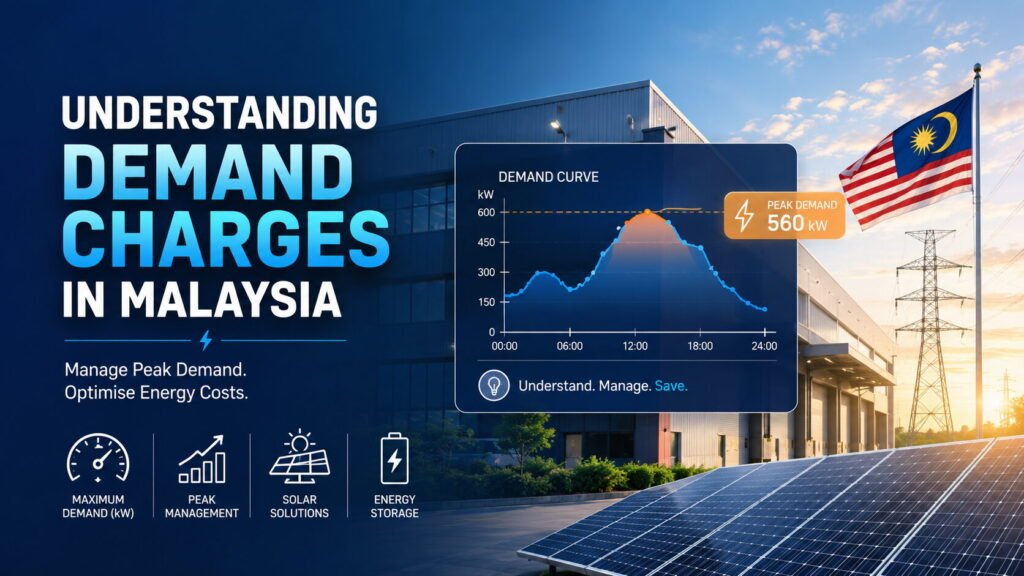
A demand charge is a component of an electricity bill associated with the highest level of electricity demand recorded during a billing period.
Tenaga Nasional Berhad (TNB) refers to this as Maximum Demand (MD).
Electricity consumption measures the total amount of electricity used over time, in kilowatt-hours (kWh). Maximum demand is different — it measures how much electrical power a facility needs at its highest point, expressed in kilowatts (kW).
For example, two factories may consume a similar amount of electricity during a month. However, if one factory operates many high-powered machines simultaneously, it could create a much higher maximum demand.
So its electricity cost structure may differ from a facility that spreads its usage more evenly through the day.
How Is Maximum Demand Measured in Malaysia?
According to TNB, Maximum Demand is the highest level of electrical demand recorded during a period — usually the monthly billing period.
TNB defines monthly Maximum Demand as twice the largest number of kilowatt-hours supplied during any consecutive 30-minute period.
In simple terms, the system looks at how much power your facility needs during its busiest moments. If several large electrical loads run at once, your Maximum Demand goes up.
Example
Imagine a manufacturing facility normally operates at around 300 kW.
At 2:00 PM, several machines, air-conditioning systems and other equipment operate simultaneously, pushing demand to 500 kW.
If 500 kW becomes the facility's highest recorded demand for the relevant billing period, that figure may affect the demand-related components of its electricity bill. The exact effect depends on its applicable tariff.
Why Do Utilities Apply Demand Charges?
Electricity infrastructure must be capable of supplying customers when their demand reaches its highest level.
This means the electricity system needs enough generation, transmission and distribution capacity to handle peak loads — even if those peaks happen only occasionally.
Demand-related charges reflect the infrastructure capacity needed to serve larger electricity users.
For businesses, this means that managing when electricity is consumed can sometimes be just as important as reducing the total amount consumed.
Which Businesses Are Most Affected?
Maximum Demand is particularly relevant to larger electricity users, especially customers supplied at medium and high voltage levels.
Businesses that may have significant peak demand include:
- Manufacturing plants and factories
- Data centres
- Shopping malls
- Hotels and resorts
- Large office buildings
- Warehouses and logistics facilities
- Hospitals
- Universities and educational campuses
- Large retail facilities
Facilities using large motors, chillers, pumps, compressors, production machinery or extensive air-conditioning systems may experience significant demand peaks.
Want to know how much you can save?
Send us your TNB bill and we will work out the system size and cost. Free, no commitment.
Malaysia's Current Electricity Tariff Structure
Malaysia introduced a revised electricity tariff structure effective 1 July 2025.
For applicable non-domestic medium- and high-voltage customers, demand-related costs can appear through components such as capacity charges and network charges, depending on the customer's tariff category.
For example, TNB's 2025 connection-charge documentation gives a sample case for a Non-Domestic High Voltage Time-of-Use customer. In that case, capacity and network charges are calculated per kilowatt of Maximum Demand during the peak period.
Because tariff structures and rates can change, businesses should refer to their latest
What Causes High Maximum Demand?

A high Maximum Demand reading often occurs when several major electrical loads operate at the same time.
Common causes include:
1. Starting multiple machines simultaneously
Large motors and industrial equipment can create substantial electrical loads, particularly when several units operate together.
2. Heavy air-conditioning usage
Commercial HVAC systems, chillers and cooling equipment can contribute significantly to peak electricity demand.
3. Production schedules
Factories running energy-intensive production lines simultaneously may create concentrated periods of high demand.
4. EV charging
Multiple high-powered EV chargers operating at the same time can add significant electrical load to a facility.
5. Poor load scheduling
Equipment may be operating simultaneously simply because there is no coordinated energy-management strategy.
How Can Businesses Reduce Maximum Demand?
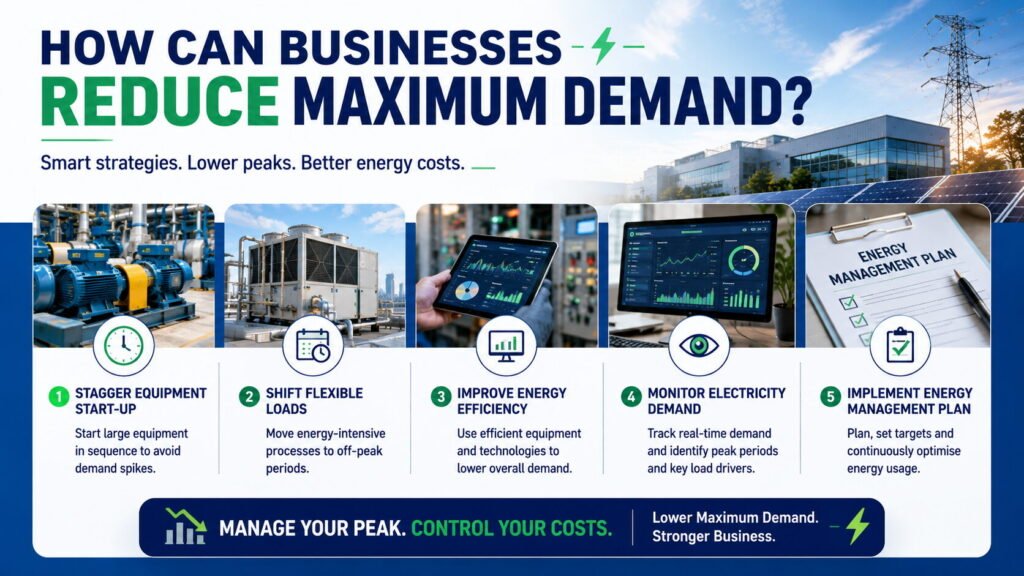
Reducing Maximum Demand does not necessarily mean reducing business activity. Often, the objective is to manage when major electrical loads operate.
Businesses can consider several strategies.
1. Stagger Equipment Start-Up
Instead of starting multiple motors, pumps, compressors or machines simultaneously, businesses can introduce staged start-up schedules. This helps prevent unnecessary demand spikes.
2. Shift Flexible Loads
Where operationally practical, energy-intensive processes can be shifted away from peak periods. TNB itself identifies peak shifting and demand-side management as approaches that can help customers manage Maximum Demand.
3. Improve Energy Efficiency
Replacing inefficient equipment with energy-efficient alternatives can reduce both overall electricity consumption and peak electrical demand.
Examples include:
High-efficiency motors
Variable speed drives (VSDs)
Efficient chillers
LED lighting
Smart HVAC controls
Building energy management systems
4. Monitor Electricity Demand
Energy monitoring systems can help businesses identify exactly when demand peaks occur. Instead of relying only on the monthly electricity bill, facility managers can analyse daily or hourly consumption patterns and identify equipment responsible for demand spikes.
Can Solar Reduce Demand Charges?
Potentially, yes—but the actual savings depend heavily on the facility's load profile and when its peak demand occurs.
Commercial solar PV generates electricity during daylight hours. If a business experiences its highest electricity demand during the same period, solar generation can help. It can reduce the amount of electricity that needs to be drawn from the grid.
For example:
Building demand: 500 kW
Solar generation at that time: 150 kW
Approximate grid demand: 350 kW
However, solar does not automatically guarantee a reduction in Maximum Demand.
If the facility's highest demand occurs when solar generation is low—for example, during cloudy conditions, early evening or at night—the impact on Maximum Demand may be limited.
This is why analysing the facility's electricity consumption profile is important before estimating potential demand-charge savings.
Solar + Battery for Demand Management
Battery Energy Storage Systems (BESS) can provide another option for businesses seeking greater control over peak demand.
A battery can store electricity and discharge when facility demand begins to rise.
This strategy is commonly known as peak shaving.
For example, if a factory normally reaches a peak of 600 kW, a battery system could potentially discharge during that period. This can reduce the amount of electricity drawn from the grid.
Combining solar PV, battery storage and intelligent energy management can provide businesses with greater flexibility in managing both electricity consumption and peak demand.
However, the financial viability depends on several factors:
- The facility's tariff category
- Load profile
- Solar generation profile
- Battery capacity
- Operating schedule
Frequently Asked Questions (FAQ)
1. What is Maximum Demand in Malaysia?
Maximum Demand (MD) refers to the highest level of electrical power a business draws from the grid during a specified measurement period. It is measured in kilowatts (kW) and can affect electricity charges for applicable commercial and industrial customers.
2. What causes high Maximum Demand?
High Maximum Demand usually occurs when several high-powered systems operate at the same time, such as production machinery, motors, chillers, air-conditioning systems, pumps and EV chargers.
3. How can businesses reduce Maximum Demand?
Businesses can reduce peak demand by staggering equipment start-up times, shifting flexible loads, improving equipment efficiency and using energy monitoring systems to identify and manage demand spikes.
4. Can solar panels reduce Maximum Demand?
Yes, solar PV can potentially reduce grid demand when solar generation coincides with a facility's peak electricity usage. However, the actual reduction depends on the business's load profile, operating hours and solar generation.
5. Can battery storage help manage Maximum Demand?
Yes. A Battery Energy Storage System (BESS) can discharge during periods of high electricity demand to reduce grid consumption. This approach is commonly known as peak shaving.
6. What is the difference between kW and kWh?
kW (kilowatt) measures power or the rate at which electricity is being used at a particular time, while kWh (kilowatt-hour) measures the total amount of electricity consumed over a period.
7. How do I know if Maximum Demand is affecting my electricity bill?
Check your latest electricity bill and tariff category for Maximum Demand or demand-related components. Businesses with more complex electricity usage can also conduct a load profile analysis to identify when and why demand peaks occur.
8. Can Arus EnerG help businesses manage electricity demand?
Yes. Arus EnerG can assess your facility's electricity consumption, daytime load and Maximum Demand profile to determine whether commercial solar or solar with battery storage could help optimise your energy usage.
Ready to start?
Talk to the Arus EnerG team first. We can survey your roof and give you real numbers before you decide.
Related posts
- Pemasangan Panel Solar Lagenda Heights, Sungai Petani: Panduan Kos & Penjimatan (2026)
Panduan ini menerangkan pemasangan solar Lagenda Heights untuk pemilik rumah dan perniagaan di Malaysia, berdasarkan terma dan angka...
14 August 202601LikeBy Arus EnerG - Kenapa Perniagaan Semakin Beralih Kepada Tenaga Solar
Nak jawapan khusus untuk kes anda?Artikel ni cover asasnya. Untuk angka dan cadangan yang tepat ikut bumbung dan...
14 August 20260LikeBy Arus EnerG - Cara Kurangkan Kos Elektrik Kilang
Nak jawapan khusus untuk kes anda?Artikel ni cover asasnya. Untuk angka dan cadangan yang tepat ikut bumbung dan...
14 August 20260LikeBy Arus EnerG