Choose Safe, Reliable Solar with Arus EnerG
Contact Arus EnerG today for a free consultation and discover how safe, efficient solar energy can power your property for decades.
Introduction
Solar panels generate electricity when sunlight is available, but what happens to the extra solar energy your system produces?
A solar battery allows you to store electricity for later use.
Instead of relying only on solar power as it is generated, a battery energy storage system stores that energy for later use. This makes power available in the evening and during periods of low solar generation. It can also serve as backup power when the system is designed for that purpose.
In Malaysia, interest in battery energy storage is growing alongside the adoption of solar PV.
The Energy Commission (Suruhanjaya Tenaga) has also introduced specific safety guidelines for Battery Energy Storage Systems (BESS). This reflects the increasingly important role of energy storage in the country's electricity sector.
But not all solar batteries are the same. This guide explains the main types of solar batteries in Malaysia. It covers their advantages and disadvantages, and what you should consider before choosing one.
Types of Solar Batteries in Malaysia: Which One Is Right for You?
What Is a Solar Battery?
A solar battery is an energy storage device that stores electricity generated by your solar photovoltaic (PV) system. Solar PV panels convert sunlight directly into electricity.
When your panels produce more electricity than you are using at that moment, a compatible solar-plus-storage system can direct some of that excess electricity into a battery.
The stored electricity can then be used later depending on the system configuration. For example, a typical solar-plus-battery system may work like this:
Daytime: Solar panels generate electricity → your property uses solar energy → excess electricity charges the battery.
Evening: Solar generation decreases → stored battery energy can supply part of your electricity needs.
Power interruption: If the system includes compatible backup functionality and electrical configuration, the battery may supply selected essential loads.
This can help property owners increase their use of self-generated solar electricity and reduce dependence on grid electricity during certain periods.
Main Types of Solar Batteries in Malaysia
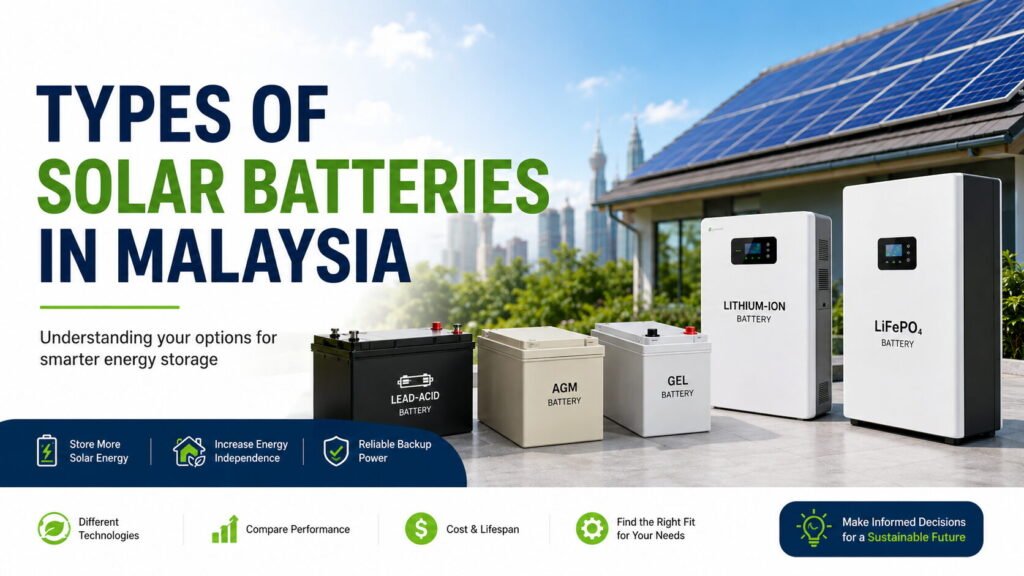
There are several battery technologies available for solar energy storage. However, their cost, lifespan, efficiency, safety characteristics and maintenance requirements can differ significantly.
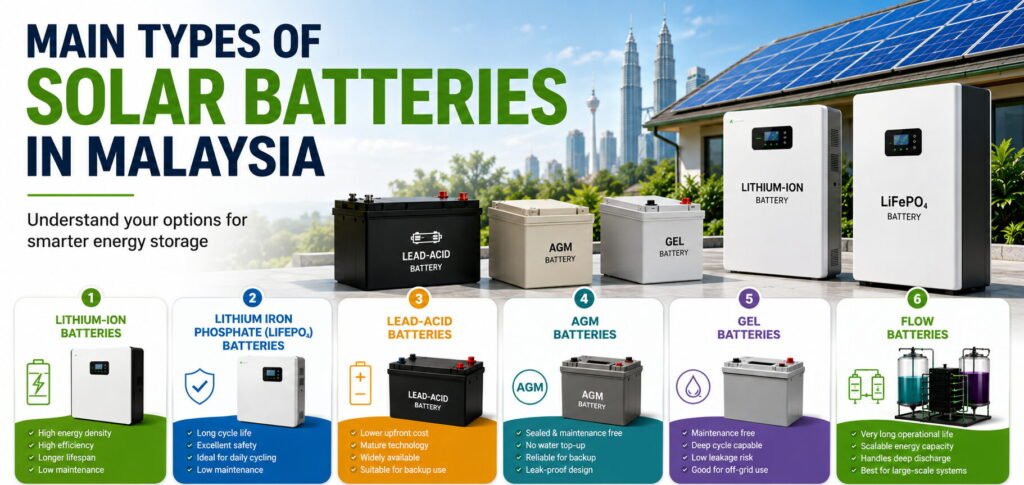
1. Lithium-Ion Batteries
Lithium-ion batteries are widely used in modern energy storage systems. They offer high energy density, relatively compact dimensions and good charging and discharging performance. These characteristics make lithium-ion technology suitable for residential and commercial solar installations where space and performance are important considerations.
Advantages
- High energy density
- Compact and relatively lightweight
- High charging and discharging efficiency
- Longer lifespan than many traditional lead-acid batteries
- Low routine maintenance
- Suitable for modern solar-plus-storage systems
Disadvantages
- Higher initial cost than conventional lead-acid batteries
- Requires an appropriate Battery Management System (BMS)
- Performance, safety and lifespan depend on battery chemistry, design, installation and operating conditions
Best suited for: Homes, offices and commercial properties looking for modern solar energy storage with good efficiency and long-term performance.
2. Lithium Iron Phosphate (LiFePO4 / LFP) Batteries
Lithium iron phosphate, commonly known as LiFePO4 or LFP, is a type of lithium-ion battery chemistry that has become particularly popular for stationary energy storage.
LFP batteries are known for their thermal stability, long cycle life and ability to handle frequent charging and discharging.
For Malaysian properties considering long-term solar battery storage, LFP is often one of the technologies worth evaluating.
Advantages
- Long cycle life
- Good thermal stability
- Suitable for frequent charging and discharging
- Low maintenance requirements
- Good option for stationary solar energy storage
- Does not use nickel or cobalt in its cathode chemistry
Disadvantages
- Higher upfront cost than traditional lead-acid batteries
- Lower energy density than some other lithium-ion chemistries
- Requires compatible inverter, BMS and system design
Best suited for: Residential solar-plus-battery installations and commercial energy storage systems where longevity and frequent cycling are priorities.
3. Lead-Acid Batteries
Lead-acid is one of the oldest rechargeable battery technologies and has been used for decades in backup power and off-grid applications.
These batteries generally have a lower upfront purchase cost than lithium-based alternatives, which can make them attractive for projects with limited initial budgets.
However, they usually have a shorter cycle life and lower usable depth of discharge compared with modern lithium batteries.
Advantages
- Lower upfront cost
- Mature and widely understood technology
- Commonly available
- Suitable for certain backup and off-grid applications
Disadvantages
- Shorter cycle life
- Lower usable capacity
- Heavier and larger
- Some types require regular maintenance
- Charging can take longer
- Generally less suitable for frequent deep cycling
Best suited for: Budget-sensitive backup systems, certain off-grid applications and systems where the battery is not expected to cycle heavily every day.
4. AGM Batteries
Absorbent Glass Mat (AGM) is a type of sealed lead-acid battery.
Unlike traditional flooded lead-acid batteries, AGM batteries hold their electrolyte within absorbent glass mats. This makes them easier to maintain and reduces the risk of liquid electrolyte leakage under normal operation.
Advantages
- Sealed design
- Low maintenance
- No routine water topping
- Reliable for backup applications
- Lower initial cost than many lithium systems
Disadvantages
- Shorter cycle life than many lithium batteries
- Heavy for their storage capacity
- Sensitive to excessive discharge
- Less attractive for intensive daily cycling
Best suited for: Small backup systems, certain off-grid installations and applications with occasional battery use.
5. Gel Batteries
Gel batteries are another form of sealed lead-acid battery.
Instead of using free-flowing liquid electrolyte, the electrolyte is mixed into a gel-like substance.
They are generally low-maintenance and can work well in applications requiring slow, steady discharge.
Advantages
- Low maintenance
- Sealed construction
- Suitable for deep-cycle applications when correctly operated
- Lower leakage risk than flooded lead-acid batteries
Disadvantages
- More expensive than conventional flooded lead-acid batteries
- Sensitive to incorrect charging voltage
- Lower energy density than lithium batteries
- Usually shorter cycle life than quality LFP batteries
Best suited for: Certain off-grid systems, backup applications and smaller solar installations.
6. Flow Batteries
Flow batteries store energy using liquid electrolytes held in external tanks.
Unlike conventional batteries, their energy capacity can be increased by increasing the amount of electrolyte storage. This makes flow batteries particularly interesting for large-scale stationary energy storage.
However, their size, complexity and cost mean they are generally not the first choice for a typical Malaysian home.
Advantages
- Potentially very long operational life
- Can tolerate frequent deep discharge
- Scalable energy capacity
- Suitable for large stationary storage projects
Disadvantages
- Large physical footprint
- Complex system design
- Higher installation cost
- Not practical for most residential installations
Best suited for: Large commercial, industrial and utility-scale energy storage projects.
Solar Battery Comparison
| Battery Type | Typical Relative Cost | Cycle Life | Maintenance | Common Application |
|---|---|---|---|---|
| Lithium-Ion | Higher | Long | Low | Home & commercial |
| LiFePO4 (LFP) | Higher | Very long | Low | Home & commercial |
| Lead-Acid | Lower | Shorter | Medium–High | Backup & off-grid |
| AGM | Medium | Moderate | Low | Backup systems |
| Gel | Medium | Moderate | Low | Off-grid systems |
| Flow Battery | High | Very long | Specialised | Large-scale projects |
Actual battery performance and lifespan depend on factors including battery quality, chemistry, operating temperature, depth of discharge, charging behaviour and system design.
Want to know how much you can save?
Send us your TNB bill and we will work out the system size and cost. Free, no commitment.
Which Solar Battery Is Best for Malaysia?
There is no single battery that is best for every property. For many modern residential and commercial solar installations, lithium-based batteries — particularly LFP batteries — are attractive because of their long cycle life, low maintenance requirements and suitability for frequent cycling.
However, choosing a battery should not be based on chemistry alone.
Consider:
- Your average daily electricity consumption
- Solar PV system size
- Battery capacity in kWh
- Maximum charging and discharging power
- Usable depth of discharge (DoD)
- Expected battery cycle life
- Inverter compatibility
- Backup power requirements
- Available installation space
- Manufacturer warranty
- Safety certifications
- Budget
- Future expansion requirements
A properly sized battery is often more valuable than simply purchasing the largest battery available.
Solar Battery Capacity: How Much Do You Need?
Solar battery capacity is usually measured in kilowatt-hours (kWh).
For example, a 10 kWh battery does not necessarily mean that the full 10 kWh is available for everyday use. The usable capacity depends on the battery's permitted depth of discharge, operating reserve and system configuration.
A household that mainly wants to store excess daytime solar for evening consumption may need a different capacity from a household seeking extended backup power.
Commercial properties also require a different approach because their electricity consumption, maximum demand, operating hours and solar PV capacity can be significantly higher.
A professional assessment should therefore consider both your electricity consumption profile and solar generation profile.
Solar Battery Capacity: How Much Do You Need?
The right solar battery is not simply the battery with the biggest capacity.
At Arus EnerG, we can assess your electricity usage, solar PV requirements and energy storage goals to recommend a system that suits your property.
Whether you are planning solar for a home, office, commercial building or industrial facility, proper system sizing helps ensure that your solar panels, inverter and battery work together effectively.
Ready to Explore Solar + Battery Storage?
Talk to Arus EnerG about a solar PV and battery storage solution designed around your energy needs.
Contact Arus EnerG today for a solar consultation and system assessment.
Frequently Asked Questions
What is the best type of solar battery in Malaysia?
Lithium-based batteries, particularly LiFePO4 (LFP), are commonly considered for modern residential and commercial solar storage because of their long cycle life, low maintenance and good performance. The best option still depends on the property's energy requirements, budget and system design.
What is the difference between lithium-ion and LiFePO4 batteries?
LiFePO4 is a specific lithium-ion chemistry. It is particularly valued for stationary energy storage because of characteristics such as thermal stability and long cycle life.
Can I add a battery to my existing solar system?
In many cases, yes. However, compatibility depends on your existing inverter, solar PV configuration, electrical system and the battery technology being considered. An installer should inspect the existing system before recommending an upgrade.
Can solar batteries power a house during a blackout?
Potentially, but only when the system is specifically designed and configured for backup operation. A battery connected to a solar system does not automatically mean the entire property will remain powered during a grid outage.
How long does a solar battery last?
Battery lifespan varies significantly according to chemistry, cycle frequency, depth of discharge, temperature, product quality and operating conditions. Lithium batteries generally offer longer cycle life than traditional lead-acid batteries.
Are solar batteries safe?
Modern battery systems can be safely operated when properly designed, installed and maintained. Battery technology, BMS protection, installation environment and compliance with applicable safety requirements are important considerations. Malaysia's Energy Commission has published dedicated BESS safety guidelines for energy storage installations.
Is a solar battery worth it in Malaysia?
It can be, particularly for users who want greater solar self-consumption, energy storage or backup capability. However, the financial case varies between properties, so electricity usage and solar generation should be analysed before deciding on battery capacity.
Ready to start?
Talk to the Arus EnerG team first. We can survey your roof and give you real numbers before you decide.
Related posts
- Malaysia Solar Scheme Timeline: FiT, NEM and Solar ATAP
Three generations of residential solar scheme in Malaysia in order: Feed-in Tariff, NEM, Solar ATAP, plus the SolaRIS...
22 August 20260LikeBy Arus EnerG - ICPT TNB Malaysia: Apa Itu & Kenapa Kini Dipanggil AFA
Ringkasan pantas: ICPT (Imbalance Cost Pass-Through) ialah caj/rebat tambahan pada bil TNB berdasarkan naik-turun kos bahan api janakuasa....
12 August 202601LikeBy Arus EnerG - Office Electricity Saving Tips for Businesses
Choose Safe, Reliable Solar with Arus EnerG Contact Arus EnerG today for a free consultation and discover how...